Myth & Memory

Written by Pinak
What we carry, what we remember?
What happens when a landscape undergoes a sudden devastating transformation? News and images of the aftermath of the destructive floods that swept through parts of Nepal at the end of August have left communities in Rasuwa, Nuwakot, and beyond mourning. Images of families, both national and international, and their painful wait for news of those still missing have cast its long shadow on our national psyche.
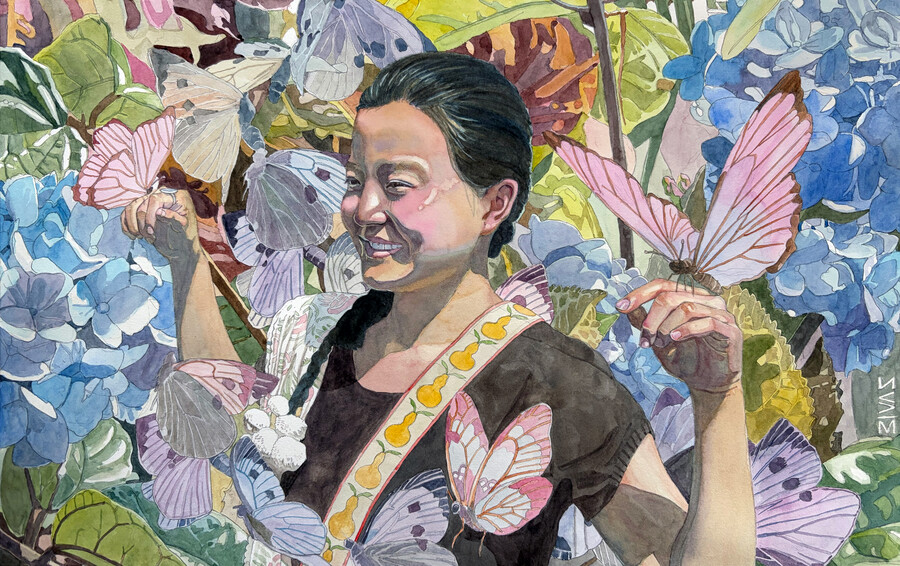
Even though we are still in a state of national mourning and trauma, the question of what remains and what the flood has physically and emotionally obliterated is a pertinent one. Can we ever reclaim what was lost? Villages hold more than homes and roads. They hold the familiar paths we take, the places where festivals are celebrated, the stories attached to a particular hill or river, and the memories of people who came before us. Much of culture survives in these seemingly ordinary acts of remembering: in stories told by elders, rituals repeated across generations, and movements learned and remembered by the body.
Myth & Memory, Bivas Rai’s first solo exhibition at Siddhartha Art Gallery, was originally scheduled to open on August 28, with the nation still in mourning over the devastating glacial outburst. In place of a formal opening, the gallery held a candlelight vigil alongside Margie Thomas, Founder of the Australian Himalayan Foundation Art Award, and Garry Weare, Chairman of the Australian Himalayan Foundation, the artist and Bivas Rai, and a handful of vistors – in memory of those who had died and those who were still missing.
The title of the exhibition brings together two forces that shape the exhibition: myth, the stories through which communities understand and pass on their past, and memory, the personal and often imperfect way those stories are carried from one generation to another. The exhibition enters this space through Sakela, the communal festival and dance tradition of the Kirati Rai community. Sakela is one of the most important festivals of the Kirati Rai community, celebrated twice a year as Udhauli and Ubhauli, following the cycles of planting and harvesting and honoring nature and the ancestors.
In this exhibition, Sakela is also a way of remembering. Much of Kirati history has traditionally travelled through oral storytelling, passed from one generation to another rather than preserved in written records. Bivas Rai grew up in an extended Rai family where somebody was always telling a story. As a child, he admits, he did not have much patience for them. Years later, he began returning to those same stories with a different kind of curiosity.
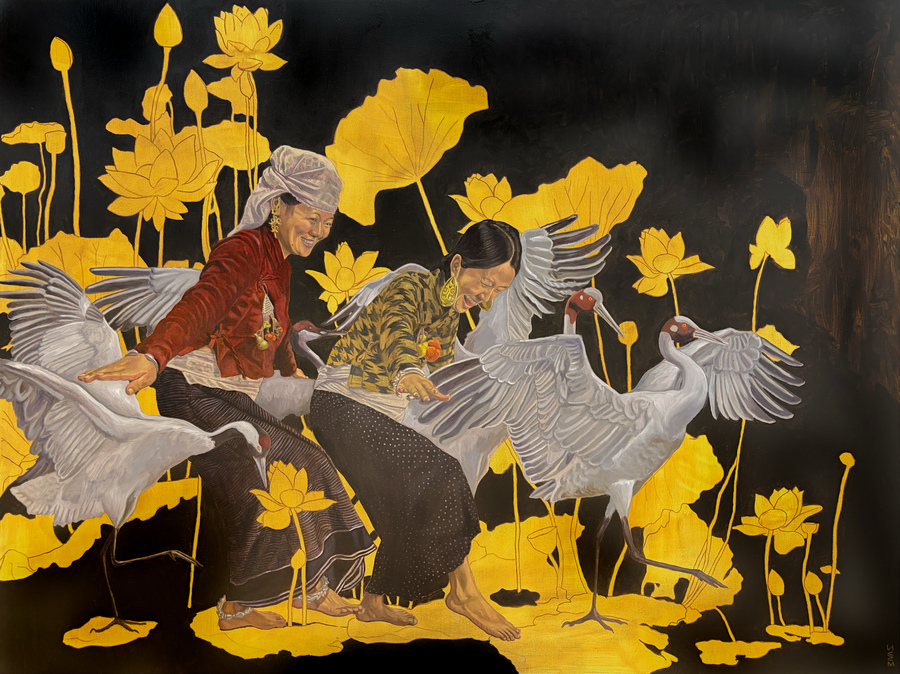
Over the past twelve months, Bivas has listened to his grandmother, mother, sisters, and other elders in his family, gathering memories and oral interpretations. A story can change from one generation to the next, from one village to another, or between different paachha, the subgroups within the larger Chamling and Bantawa lineages. Rather than searching for one definitive version of Kirati folklore, Bivas accepts that memory is imperfect, shifting, alive, and perhaps that is precisely how it survives.
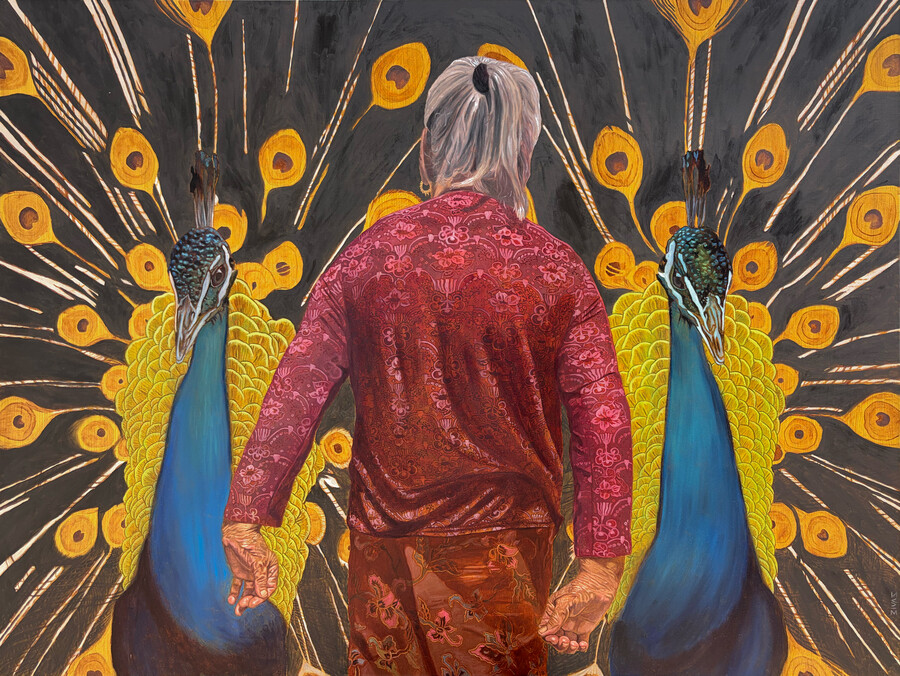
His grandmother, whom the family calls ‘Kokuji’, remembers the Tawa Silli, or peacock dance, through the movements of the people she watched growing up and through a detail that has since shifted. “Back in the day, mostly men used to dance; women didn’t dance as much,” she recalls. “As you dance, you move together and slowly spread out, like a peacock (mujur) fanning its feathers and turning. My grandfather (hajur baje) and paternal aunt (fupu) used to dance it, while the older women (boju haru) stayed back. Just like the painting, you open your arms wide. Year after year, I learned by watching others move. ” In Tawa Silli, she appears at the center of that remembered gesture, a woman placed where the dance itself once made room mostly for men. She stands with her back to the viewer, her white hair in contrast against a deep ground, while two peacocks spread their tails around her, an image that feels almost like a memory itself: incomplete, fleeting, and deeply personal. “Seeing my grandson’s painting of this memory brings me so much joy,” she says. “I give him all my blessings.” The grandmother who once danced, the artist who now remembers her, and the younger generation who may know her only through the stories of others briefly meet within the same frame. Bivas Rai’s sisters, meanwhile, bring that memory into the present.
Yet in Sakela, memory does not travel through words alone; it moves through the body. The silli are the movements performed during the festival, each one drawn from the behavior of a living creature: the ant, the tiger, the wild boar, the bird, and the peacock. The Silliboma and Sillibopa, the female and male leads, begin the movements and establish the rhythm for the community to follow. Rai’s dancers are not imagined figures from an ancient past; instead, they wear the clothes of the present: casual clothes, streetwear, traditional dress, or a mixture of all three. It is a small but deliberate juxtaposition: the style is centuries old, but the body performing it belongs entirely to now.
That sense of intimacy becomes even more apparent in Rai’s treatment of family. Beneath the stories of Sakela runs a quieter story of sisterhood and matriarchy. Rai grew up surrounded by his grandmother, mother, aunts and sisters, and the women in his family who have shaped the world from which these paintings emerged. Every work in the series includes one of his sisters. “All the beautiful human beings that you see in my painting are my family members, mostly my sisters,” Bivas Rai says. So each of them was asked the same question: what was it like being painted into this exhibition, and did seeing themselves inside a Sakela composition change how they think about the festival or their family’s stories?
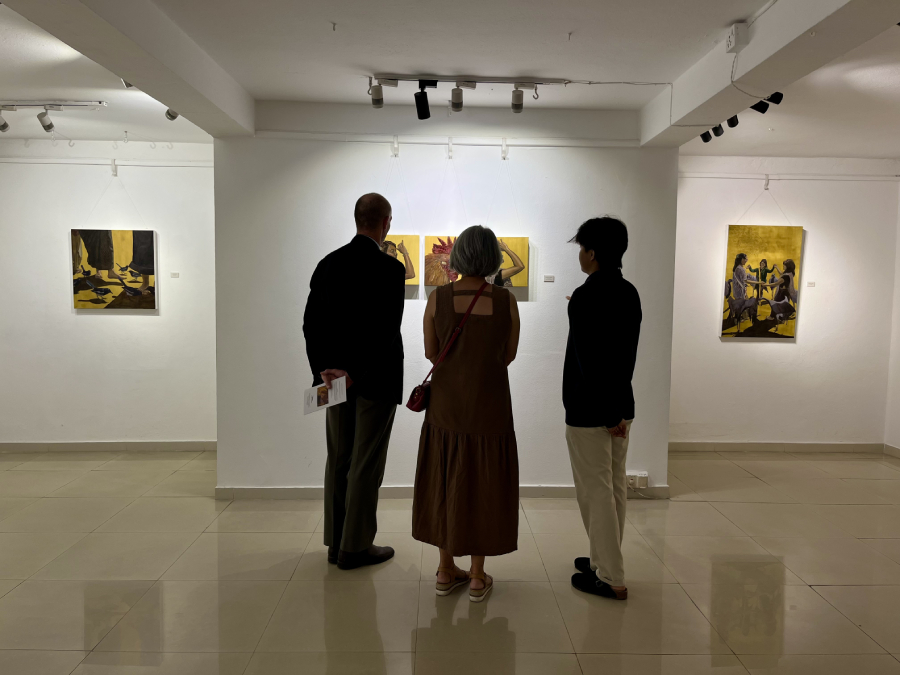
For Aslesha, it “felt deeply personal. These aren’t just family stories;; they’re a record of who we are, and I’ve always felt our heritage needed to be documented for generations to come.” For Anisha, Sakela has always been “more than a festival”; it is “our identity, our traditions, and our living history.” Seeing myself in the composition, captured by my brother, felt like preserving a piece of our family and culture to carry forward.”
Manasvi found something strange in it. “Sakela is something I’ve always known through movement: the thunder of the drums, the gathering in a circle, and the silli we learn by copying our elders until the steps live in our bodies,” she says. “Then I walked into my brother’s exhibition and saw myself still in the middle of it, in the Tiger Silli (Baag Silli, also called Kiwa Silli). ” What struck her most was who Bivas Rai had chosen to paint: “He painted only the women of our family. Kirati culture has survived largely without written texts, carried through ritual, dance, and oral storytelling-and so much of that carrying has been done quietly by women. Seeing us at the center of his canvases felt like that invisible labor was finally being seen. We no longer know the names or faces of most of our ancestors, but when we step into the circle and move the way they moved, we are dancing with them. Centuries stand between us, and yet it is the same dance.”
Suravi, painted alongside the wild boar of Phakpa Silli, also known as Badel Silli, says, “I always understood why we danced Sakela, but I had never fully reflected on how closely each step mimics nature and animal movements,” she says. “As a Rai, I’ve grown up hearing about our deep respect for the natural world, but seeing it rendered on canvas transformed that abstract idea into something tangible.”
Taken together, their responses point to something larger within his work. Kirati culture has survived through ritual, dance, and oral storytelling, and much of that knowledge has been carried within families. The women in Bivas Rai’s paintings are therefore not simply models for his compositions. They are part of the chain through which memory has reached him.
There are also differences within Rai’s own family history. His mother’s side is Chamling, and his father’s side is Bantawa, and for Rai the distinction runs deeper than dialect. “Growing up, our elders mostly spoke Nepali at home, so I didn’t learn much of the Kirat languages directly,” he says. “Even so, the subtle differences between the Chamling and Bantawa sides were always present—particularly in how the languages sound and how specific ancestral rituals like Kul Puja are carried out. According to his mother, Chamling and Bantawa are actually among the closest and most similar Rai languages, compared to others like Bahing or Koyu, which are quite distinct from one another.” As ancestors migrated across different regions, rivers and difficult terrain cut groups off from one another, and communities split into paachha, or subgroups, partly so that marriages could take place outside the immediate line. Over generations of isolation, words shifted, some lost, others invented to fill the gaps—leaving related languages with a shared structure but distinct vocabularies.
As for the dance itself, those old distinctions have mostly dissolved. “It’s harder to isolate distinct Chamling or Bantawa sillis today,” Bivas Rai says. “The community dances together in the same circle, blending steps into a shared experience”unless a village chooses to perform its local style strictly as intended.
His grandmother speaks of something similar when she considers the generation that has not yet learned the dance. “The children of the next generation aren’t quite ready to dance yet—they haven’t gotten the hang of it,” she says. “But once they grow up, being children of Kirati and Rai lineage, one day they will naturally seek out the dance and discover it for themselves. “What matters,” she explains, “is that they remember the rituals around it: the prayers to ancestors (Pitra bujhauda), the Faagu performed roughly a week or ten days later, the planting of the sacred seuli branch, the moparo and savory rice (chamre) served on leaf plates (tapara), the farm tools placed at the base of the seuli, the dancing, and the offering of jaand.” The details may be remembered differently, but the act of remembering remains.
That question of what continues once the people who carry it are gone, or the place itself disappears, is not a hypothetical one this year. Nepal’s art community has responded to the Rasuwa floods with fundraising exhibitions and relief drives. Gallery 108’s “Art for Relief” initiative sends the full proceeds from donated artworks toward food, shelter, and supplies for affected families. Gallery MCUBE has dedicated an exhibition to the victims while collecting financial and medical contributions. The Kalā Salon is directing proceeds from its Manang Artist Residency exhibition to relief efforts, with transfer receipts for full transparency. The Nepal Academy of Fine Arts has announced a fundraising exhibition with all proceeds going to the Prime Minister’s Relief Fund. Siddhartha Art Gallery and Kathmandu Art Gallery are making their own contributions: part of the proceeds from Myth & Memory and KAG through the online September Collection 2026, both directed to the same fund.
Perhaps this is what lingers after walking through Myth & Memory. The paintings do not offer culture as something fixed and safely preserved in the artists brushstrokes or lines. They show it in motion in a grandmother’s remembered gesture, in a sister appearing on a canvas, in an elder’s version of a story, in a dancer following the rhythm of the person beside them.
Myth & Memory leaves us sitting somewhere between two feelings: the ache of knowing that memory is fleeting and the pleasure of finding it still alive. Perhaps what we carry forward is not an exact version of the past, but fragments of it – a story, a movement, a face, a song, a gesture. And perhaps the question is not simply what we remember, but what we choose to hold onto and rebuild.